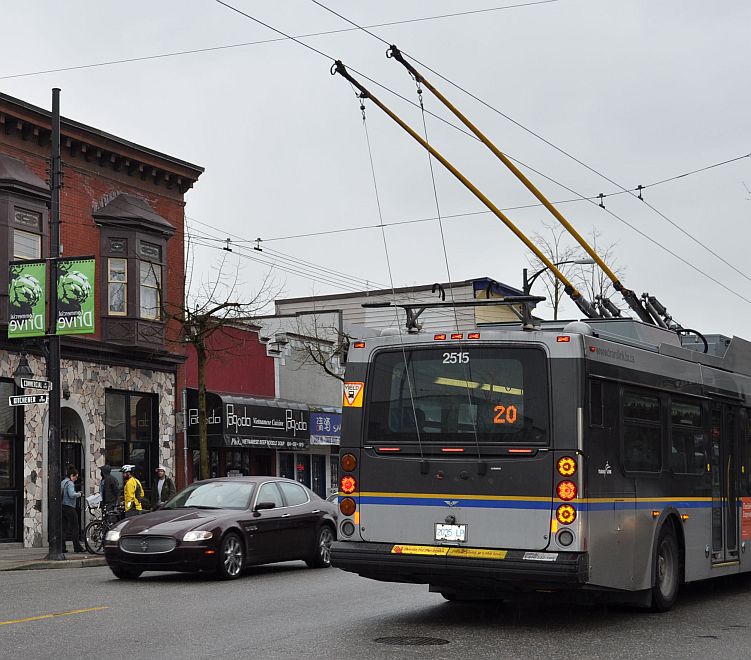
1 free tip for the TransLink mayors

April has seen continuing turmoil at TransLink, Metro Vancouver’s transportation authority, generating widespread coverage from mass media and from bloggers.

A root cause of TransLink’s financial and administrative problems, in the view of many, is the convoluted governance structure outlined in the authority’s Governance Manual and 2012 Base Plan.  This structure leaves the region’s mayors taking political heat but having little control.  Public and media blame the TransLink Mayors’ Council for the system’s failings,  but the council lacks even a dedicated staff person at the transit corporation’s offices.  Annual operating plans are devised by a Board, which is  appointed by a revolving Panel.  The mayors “review and provide input.” Continue reading

Public transit and politics in Metro Vancouver

The Premier of British Columbia, Christy Clark, has expressed her intention to audit Metro Vancouver’s transportation authority and reduce operating costs.

Regional mayors went out on a limb last year with apparent provincial support, approving a $70 million supplementary transit plan with a $30 million revenue shortfall.  New revenues were to be identified in 2012, but the process has become  messy.  The Premier’s statement, offered without backup documentation, can be seen as a poke at the mayors and TransLink staff.   She is clearly banking on the belief that public opinion is on her side. Continue reading

Rapid transit and politics in Republican Arizona

Arizona has a reputation as one of the most conservative states in the star-spangled republic.  However, the three-year-old Light Rail system in Metro Phoenix points out the persistent diversity on the Arizona political scene.

Light rail runs from the edge of Mesa into central Phoenix, serving university campuses, the international airport, and the Phoenix cultural, entertainment and financial districts.  As of early 2012, it also ran through the heart of Democrat Metro Phoenix, crossing four of the five Phoenix-area electoral districts that were dominated by Democrats in the state House of Representatives — districts that provide close to half the Democrat strength in the state House.  One would almost conclude that Democrats (disproportionately Latinos, blacks, gays and young people) are drawn to transit-friendly areas.  [November 27, 2012: New maps, new state legislature.  The train crosses still crosses four state electoral districts, but the Democrats now hold five of the eight seats within the new boundaries.]  Continue reading

Gloucester Estates: industry at the margins

For a society that consumes so much stuff, it’s remarkable how we like to push  industrial production and distribution out of sight.

In Fraseropolis, most industrial zones are screened from the view of people sitting in their living rooms or standing on their lawns, and the number of vehicle access points to industrial zone is kept to a minimum.  The biggest issue is trucks.  We don’t want them near residential streets.  They rattle the teacups.  They are feared as a threat to pedestrians and property values.

A couple of decades ago, decision-makers in the Township of Langley went the extra mile in banishing industry to the margins, creating Gloucester Industrial Estates in a rural area near the municipality’s eastern boundary.  (We’re talking fabrication, assembly, food processing and warehousing here, not black smoke.)  Gloucester has good access to the Trans-Canada Highway, but it is far from any residential area and most services.  Continue reading