Fraseropolis hospitals trail in CBC survey

An A+ rating: Saskatoon City Hospital (photo from BTY Group)

An A+ rating: Saskatoon City Hospital (photo from BTY Group)

Based on its national survey of hospitals, the Canadian Broadcasting Corporation  finds that more than half the lowest-ranked hospitals in Canada are located in Metro Vancouver.

The survey results, released on April 10, 2013, award a grade of “D” to Vancouver General, UBC, Surrey Memorial, Burnaby and Ridge Meadows hospitals. Of 239 hospitals rated in the survey, only nine fall into the “D” category, for performance (says CBC) “substantially below that of a typical hospital of the same size.” Rounding out the “D” category are two hospitals in Alberta and two in Saskatchewan.

Of 31 hospitals in CBC’s “A” category, none are located in British Columbia. Alberta is  over-represented in the “A” group with 11 placements.

Disclosure: I’m a former community relations advisor to the Fraser Health Authority, which operates three of the hospitals listed above. In my job, I frequently responded to customer questions and complaints; I’m aware that public expectations of health care are high, and that news media are often mischievous in reporting on health care issues. I also know that health authorities across Canada put considerable effort and money into trying to improve their systems.

For its survey, CBC considered information published by the Canadian Institute for Health Information, other data gathered through published sources and written requests, and ratings submitted voluntarily to the CBC website by consumers.

More than 300 Canadian hospitals were not rated due to a shortage of data. Indeed, the broadcaster says it faced serious obstacles in gathering data: it says the federal government and the provinces collaborated in refusing to cooperate with the survey.  Only New Brunswick, PEI and Nunavut responded to CBC inquiries.

Canada’s health authorities, including those in Vancouver and the B.C. Interior, have dismissed the survey as invalid. David Ostrow, CEO of the Vancouver Coastal Health Authority, says the results are subjective and incomplete. He also complains that the CBC is using one yardstick to compare hospitals with radically different types of caseloads. That is, some hospitals are required to cope with sicker or more difficult patients than other hospitals. No doubt; but should we conclude that British Columbians are generally sicker and more troublesome to treat than people in Ontario?

The CBC deserves credit for taking on this project, and for applying pressure on governments to release more information on health care management. However, these are sensitive and complicated issues, and I would award the folks at CBC a “C” grade, or maybe a “D,” in their handling of the release. In future, the survey team should put their consulting health experts front and centre, to anticipate some of the pushback that is certain to come from health administrators and professionals. Second, CBC needs to mount a persuasive argument for combining consumer popularity ratings with hard evidence on outcomes. Finally, the results for each hospital are scanty; it’s not clear how the various inputs have been weighted to produce the final grade. In the end, the picture that emerges is cloudy, although the overall trend is troubling enough to merit further investigation.

The current standings in the CBC hospitals survey, for Metro Vancouver and the Fraser Valley:

B overall: Abbotsford General, Chilliwack, Eagle Ridge, Langley, St Paul’s, Mount St Joseph, Peace Arch, Richmond

C overall: Lions Gate, Royal Columbian

D overall: Burnaby, Ridge Meadows, Surrey Memorial, UBC, Vancouver General

Not rated: Delta, Fraser Canyon, Mission Memorial

Not mentioned in the survey list: BC Children’s, BC Women’s

The plan to grow Richmond Brighouse

Saba Road, Richmond

Saba Road, Richmond

We visited Richmond to see the Brighouse district, tagged by local government as an emerging urban village. We parked on the mall roof, an unvillagey place to start. After a walkabout of the area, our friend Bob Smarz decided that this is a real neighbourhood,  judging from the vitality of the Asian shops and the Public Market. I am undecided.

Richmond Centre mall

Richmond Centre mall

In its 2011 census, StatsCan put Richmond’s population at 190,000, with more than 40 per cent of residents speaking a language other than English at home.  Richmond city officials want to focus future population growth in the central area (see page 2-3 of the 2009 Central Area Plan), mostly in six designated urban villages. As I said in my previous post, I find the “village” vision difficult to grasp: the same six precincts would see significant growth in commercial, industrial and public-sector employment, and would also provide cultural and entertainment services on a regional scale.

Cooney Road

Cooney Road

A couple of the supposed  villages are currently almost devoid of people, but Brighouse registered more than 8,000 residents in 2006. (It’s named for Samuel Brighouse, an early settler.) Under the Central Area Plan, the Brighouse population is supposed to triple, with development spurred by the new rapid transit link to downtown Vancouver. Most of the incomers will live in towers east of the main thoroughfare, No. 3 Road; existing detached homes and walkups will fall to the hammer. Much of the land to the west is already occupied by the mall, the Richmond General Hospital, Richmond City Hall, hockey rinks and Minoru Park. The elevated rapid transit line dominates No. 3 Road, greatly reducing (in my view) its potential as a pedestrian-friendly high street.

Land use map for Brighouse Village from the 2009 Richmond Central Area plan. The colours, from right to left, signify townhomes, dense mixed use, even more dense mixed use, and park. The diamonds mark institutional uses.

Land use map for Brighouse Village from the 2009 Richmond Central Area plan. The colours, from right to left, signify townhomes, dense mixed use, even more dense mixed use, and park. The diamonds mark institutional uses.

After parking the car and traversing the mall, Mr. Smarz and I stopped for lunch at Legends Pub on Buswell Street, where the clientele was distinctly non-Asian. The bartender, whose name is Rooster, said that the property housed a federal unemployment office in the 1980s and various nightclubs in the ’90s. It is now slated to be torn down, along with the surrounding complex, and redeveloped as a mixed-use tower. The owner is seeking a new location for the pub.

Canada Line 2Rooster grew up not far away, on a street of detached homes near a race track. The track disappeared in favour of the Lansdowne Centre mall and two rows of apartment towers; the people of the old community have dispersed. He said that there’s nothing in central Richmond today that would qualify as a walkable concentration of shops and services.

Looking across Brighouse Square shopping centre from No. 3 Road

Looking across Brighouse Square shopping centre from No. 3 Road

We proceeded to Park Road and two strip malls that are entirely taken up with Asian markets and restaurants. They were enjoying a busy Saturday, like the Brighouse Square plaza shown on the right. Bob took the view that this concentration of lively independent businesses, marks Brighouse as a true neighbourhood; I saw automobile dependency, with customers probably coming from a wide area to shop for items that may be rare in Delta or Surrey.

Public Market, Richmond If redevelopment takes place as planned, the plazas will disappear in time. The Richmond Public Market, facing on Westminster Highway, offers one model of what might replace them. It is attractive in its architectural conception, if worn at the edges, and it is well integrated with the flow of pedestrian traffic on the street. A 2011 post on the Chow Times praises the variety and low prices of the Asian food. One reader of the post called the Public Market “the closest thing in the lower mainland to a traditional Asian market.”

As an outsider, I can see the advantages to living in this part of Metro Vancouver, above all for Chinese speakers. But I can’t tell you whether there is true community here, or just an odd mix of towers, retail uses and ’60s-era sprawl. The City is facilitating the growth of community associations, including a City Centre Association (although not a Brighouse Association). It may be that with time and local champions, Brighouse will build its niche and its reputation.

Richmond Public Market interior

Richmond Public Market interior

A wider definition of “urban village”

Behind the Public Market, Brighouse Village, Richmond City Centre

Behind the Public Market, Brighouse Village, Richmond City Centre

We launched the Fraseropolis Urban Villages project in March 2012, six months after opening this site. Our amateur definition of “urban village” focuses on places where residents can find everyday services, transit and housing choice within easy walking distance. Not everyone wants to live in a village; but a successful village attracts enough people that business and community life flourish.

Richmond City Centre

Richmond City Centre

The City of Richmond, British Columbia, in its 2009 whopper of a City Centre Area Plan, looks at the urban village in an expanded way. The Plan describes villages as a key part of the City’s City Centre development strategy, and identifies six of them. (“Candidate villages” might be a better name, since most of them exist only on the drawing board.) The Plan says that “‘Urban village’ is another name for the type of compact, walkable, transit-centred community encouraged by Transit-Oriented Development.”  Page 1-10 lays out a grid of required or encouraged village features. Continue reading

Time to plant onions

Garlic tops, Pitt Meadows, March 30, 2013

Garlic tops, Pitt Meadows, March 30, 2013

The West Coast has warmer winters than the rest of Canada, and a relatively long growing season. The Lower Mainland, as I’ve mentioned before, generates two-thirds of the agricultural value in British Columbia.

Metro Vancouver, the more urbanized half of Fraseropolis, has the biggest area of any B.C. county devoted to potatoes, beans, lettuce, Chinese cabbage, beets, carrots, spinach, rutabaga/turnips, pumpkins, shallots and green onions, blueberries and cranberries. Continue reading

West Broadway village: genteel densification

Coach house, Trafalgar Street, Vancouver

Coach house, Trafalgar Street, Vancouver

For decades, the City of Vancouver has pursued a strategy of creating new, densely-populated residential zones around unused industrial lands. (Yaletown is a good example.) Efforts to densify residential zones have generally been more cautious. When Council goes for the gusto, as with the multi-tower King Edward Village in the neighbourhood around Kingsway and Knight, public opposition is often bitter.

Larch Street: two units accessible from the main floor, one from the ground floor.

Larch Street: two units accessible from the main floor, one from the ground floor.

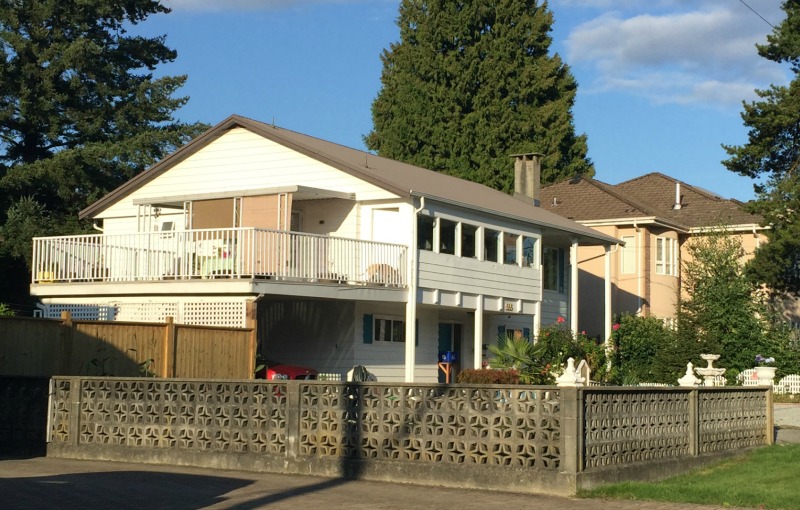
Vancouver’s West Broadway area is an example of creeping densification, an approach  designed to improve housing choice without triggering civil war. It’s achieved mostly by placing new mini-homes on large properties (as shown above), or by dividing vintage homes into multiple units (as on the left.) Continue reading

Port Moody plans transformation to greet Evergreen Line

A concept view of the future approach to the Clarke Road/Barnet Highway intersection, arriving from Vancouver on the Barnet. From the City of Port Moody draft OCP, March 2013

A concept view of the future approach to the Clarke Road/Barnet Highway intersection, arriving from Vancouver on the Barnet. From the City of Port Moody draft OCP, March 2013

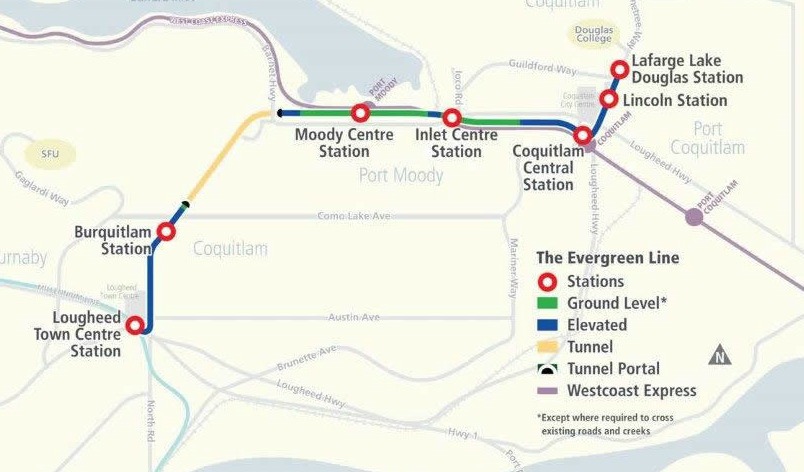
The City of Port Moody, a part of Metro Vancouver, has unveiled a draft Official Community Plan that would enable densification or superdensification along the new Evergreen rapid transit line, on track for completion in 2016.

The updated Community Plan, commissioned by City Council in early 2012, shows that Port Moody’s population grew from 18,000 in 1991 to 34,000 in 2011. Part of that growth anticipated the arrival of rapid transit with the creation of a pair of trendyish tower-dominated neighbourhoods, NewPort Village and its clone. The TriCity News reports that the next round of planning changes could help push the local population to 60,000. In a commentary posted on March 21, 2013, the paper’s unnamed editorial writer votes in favour. Continue reading

Downtown New West goes for the big time

Columbia Street

The riverfront city of New Westminster enjoyed a long history as an industrial and commercial hub separate from Vancouver. But as suburban populations and shopping malls grew to the east, north and south, New West lost something of its distinctive position and much of its commercial market.

The City government responded with repeated beautification efforts and a failed attempt to launch a new Granville Island development at Westminster Quay; but through 1980s and 90s, Columbia Street, the downtown area’s high street, grew increasingly frazzled and transient. Continue reading