Will success transform Commercial Drive?

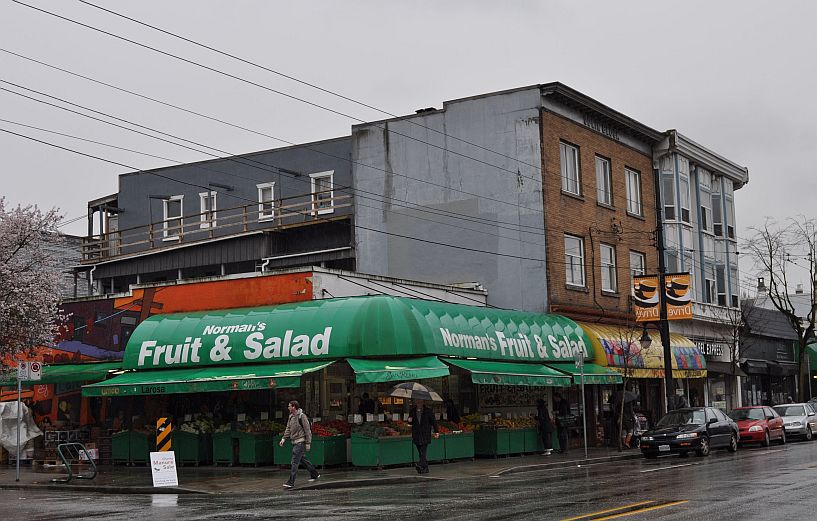
Aside from ethnic enclaves, Vancouver’s Commercial Drive area may be the most distinctive urban village in B.C.’s Lower Mainland.  But its funky, quirky nature attracts visitors, and the visitors attract developer interest, and the developer interest may eventually erase the street’s one-of-a-kind character.
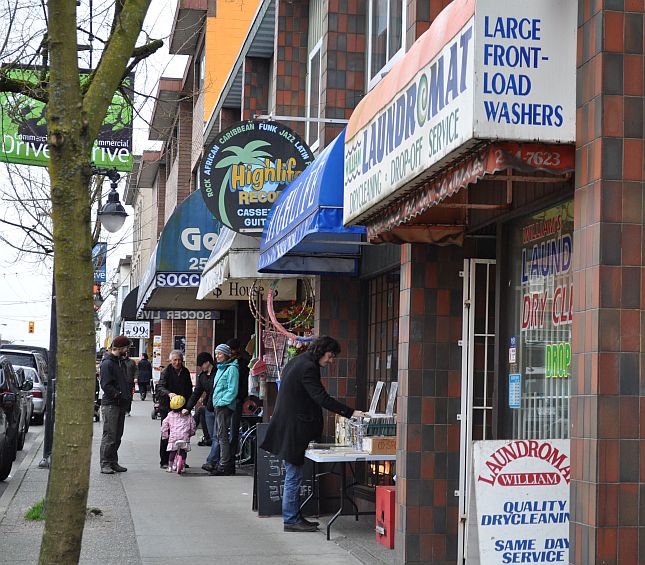
Once a largely Italian district, The Drive morphed during the 1980s into a resolutely downmarket ghetto for artists, thinkers and social activists. When the provincial New Democratic Party was ejected from government in 2001 and reduced to two seats in the legislature, Commercial Drive formed the centre line of the NDP’s remaining strength. Continue reading

You could win a trip to fabulous Cloverdale

On a cloudy but dry Saturday afternoon, the sidewalks of old Cloverdale were almost deserted.  This village in the city of Surrey, B.C. makes a good starting point for the Fraseropolis.com Urban Villages project: it has potential as a residential and commercial centre, but its future prospects are unclear.

Cloverdale village sits at the junction of provincial highways 10 and 15, providing easy access from much of Surrey and Langley.  Its identity dates from the days of the Interurban commuter railway line, which ceased operation in the 1950s.  Settlement began in the 1870s, but the vintage architecture appears to date from about 1930.  Its “Anytown USA” look attracted the makers of Smallville, a now-defunct television series about the boyhood of the comic-book hero Superman.  At the time of this post, the Cloverdale Business Improvement Association still promoted the village as “The Home of Smallville”, although the cameras for the Superman-as-teenager TV series had been gone for some years. Continue reading

The Fraseropolis.com “Urban Villages” index

This post marks the online launch of our “Urban Villages” project.

Fraseropolis, a notional two-county region on British Columbia’s Pacific coast,  is unique in Western Canada in the number of historic towns and villages that have been absorbed into the urban fabric.  Mission City, Maple Ridge, Chilliwack,  Cloverdale and others pre-date 1900.  A very few — Fort Langley, White Rock — have blossomed as regional tourist destinations.  Most struggle on as secondary shopping areas overshadowed by nearby malls. Continue reading

The suburban high street at risk: a Fraseropolis example

The modern history of Canadian cities can be written partly as a struggle between the pre-1939 shopping street — or high street, as they say in the UK — and the automobile-oriented shopping centre.

The high street has seen repeated setbacks, with the creation of full-service shopping centres in the early 1960s, the covered mall a few years later, and the big box more recently.  In most cases, the shopping centre offers the retailer a reduced level of risk in terms of customer traffic levels, security, building maintenance and flexibility for expansion or contraction.  For the shopper, the shopping centre often promises lower prices and an escape from the weather.

In fact, the high street has become something of a niche phenomenon — patronized by the carless, by friends and supporters of individual merchants, or by odd ducks who like to walk and browse but not necessarily buy.  Continue reading