Child poverty in Metro Vancouver

A detail from the 2014 Child Poverty Report Card. Areas of highest concentration (over 40 per cent) include a set of communities east of Vancouver's downtown, Squamish territory at the north end of the Lions Gate Bridge, and Metrotown in Burnaby.

A detail from the 2014 Child Poverty Report Card. Areas of highest concentration (over 40 per cent) include a set of communities east of Vancouver’s downtown, Squamish territory at the north end of the Lions Gate Bridge, and Metrotown in Burnaby.

Some Canadians are much healthier than others. Poor health outcomes are more likely among: children and families living in poverty; the working poor; the unemployed/underemployed; those with limited education and/or low literacy; Aboriginal and remote populations; newcomers; persons suffering from social exclusion; the homeless; and those who have difficulty securing affordable housing. — Final Report of the Senate Subcommittee on Population Health, 2009

In late 2014, the BC Child and Youth Advocacy Coalition issued a Child Poverty Report Card organized into 10 fact sheets, including a fact sheet on Metro Vancouver.

For this website, the takeaway is that poverty thrives in all parts of Metro Vancouver, though it may not show up at street level.  Besides the often-documented Downtown Eastside, there are zones where poverty is common in Richmond, Burnaby (including Edmonds, discussed in our February 2 post), Surrey, Langley — and in fact, in almost any urban centre. Continue reading
The mayors’ case for a transportation tax


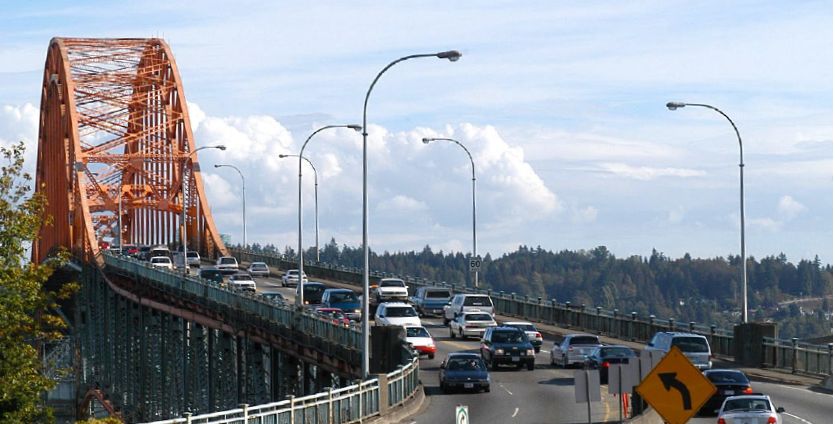
Replacement of the 1937 Pattulo Bridge over the Fraser River is part of the Metro Vancouver mayors' long-term plan. The photo is taken from the plan document.

Replacement of the 1937 Pattulo Bridge over the Fraser River is part of the Metro Vancouver mayors’ long-term plan. The photo is taken from the plan document.

Vicki and I attended a luncheon last week to hear from advocates for a Metro Vancouver transportation tax. The tax proposal will be the subject a ballot going out to households in March.

In 2014, regional transit mayors issued a long-term plan for upgrades to rapid transit, bus transit, regional roads and HandiDart service. The British Columbia government responded that any proposal for new fees or taxes to support the plan must be tested in a referendum. (The parties use the term “plebiscite”, but the difference seems academic.) Continue reading

Accepting the shift in Burnaby Edmonds

Residential towers adjacent to the High Gate Centre, Edmonds

Residential towers at Highgate, Edmonds

With a population of 234,000, Burnaby is the third-largest city in Metro Vancouver and in British Columbia. It has no single centre. City Hall sits in science fiction isolation beside tranquil Deer Lake and its park. Commercial and residential growth is focused in “town centres,” three of them anchored by enormous shopping malls: Brentwood, Lougheed and especially Metrotown.

Edmonds, a fourth town centre, is the runt of the litter. I travelled there to measure its shapeKingsway 3 and size in summer 2014,  landing at Greenford Ave. and setting out along the south side of  Kingsway. Other than a block of shops on the north side, Kingsway seemed kind of a mess, mixing automotive lots with ageing towers.

I held out hope that Edmonds Street, narrower and quieter, would offer  more charm. The intersection of Edmonds and Kingsway was the site of the first Burnaby municipal hall, built in 1899 when this was still a rural district. Edmonds Street, five kilometres east of Metrotown, has the makings of a village shopping street, supported by decent public transit and a stock of nearby walk-up apartment buildings. Continue reading

The freeway islands, Langley, British Columbia

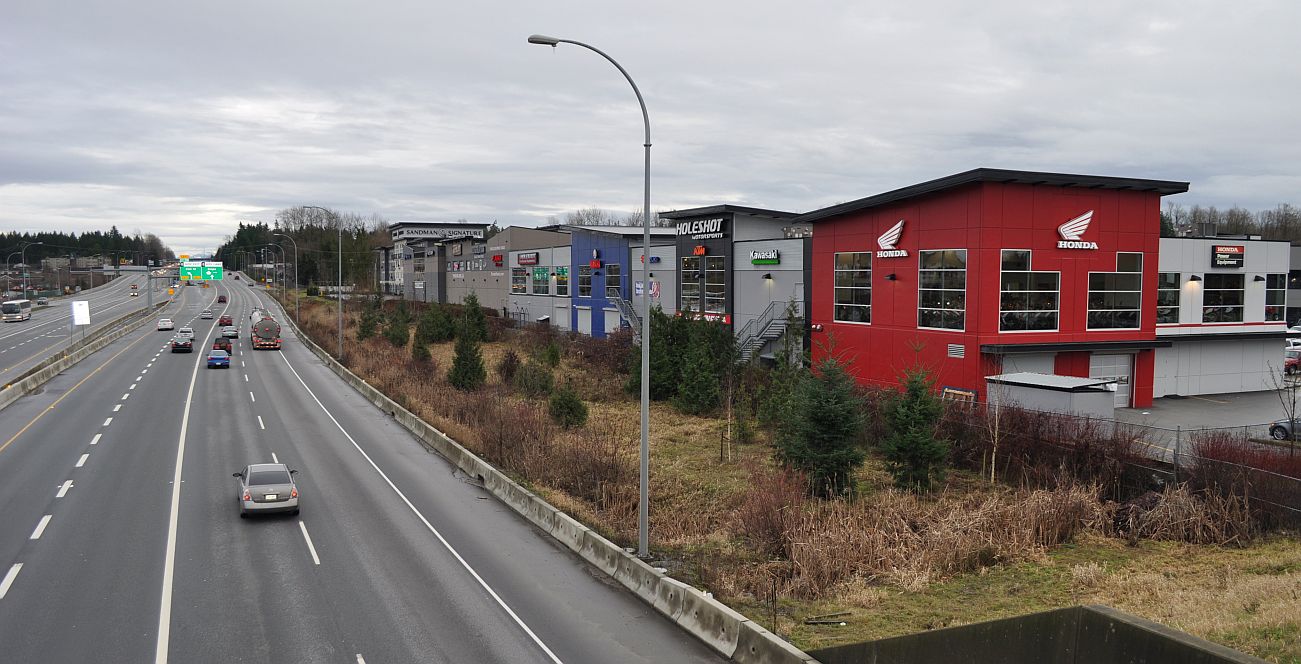
Commercial development, right, is surrounded by components of the 200th Street Interchange

Commercial development, right, is surrounded by components of the 200th Street Interchange

In 1999 or thereabouts, the British Columbia government and Langley Township agreed to locate commercial development within a new Highway 1 interchange at 200th Street, replacing a crumbling structure from the Diefenbaker era. Interchange traffic would be controlled by several sets of traffic signals, a departure from freer-flowing design traditions. Continue reading