 British Columbia Auditor-General John Doyle’s omnibus report on the B.C. government’s reporting practices states that the Port Mann project office (the Transportation Investment Corp.) should not be categorized as a “government business enterprise” since its prospects for profitability are murky. “The financial model developed by the TIC forecasts that it will not be profitable until 2017/18,” says the A-G. Perhaps more significantly, he adds, the government’s traffic and revenue estimates may be wrong. The Port Mann project investment, he suggests at the top of his report, should be regarded as taxpayer-supported debt. Continue reading
Monthly Archives: September 2011
Should Metro taxpayers pay for Vancouver streetcars?
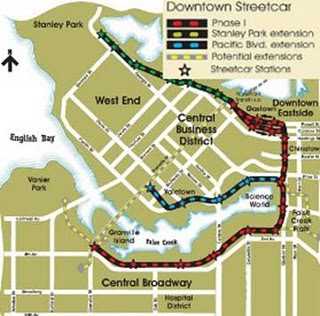
The proposed downtown Vancouver streetcar network
A streetcar plan recently revived by City of Vancouver mayoralty candidate Suzanne Anton is definitely kool. Anton’s September 21, 2011 announcement is based on a 2005 consultant’s report putting the capital cost of a Granville-Island-to-Waterfront streetcar line at $100 million (in 2005 dollars.) Annual operating costs are estimated at $3.6 million, with a ridership on the order of 5 million people per year by 2021.
Anton’s funding strategy, vaguely outlined, would see the City joined with private partners to fund the line. Vision Vancouver Geoff Meggs responded that the streetcar system is not a priority; but if it is to be funded, it should be paid for by taxpayers across Metro Vancouver through TransLink.
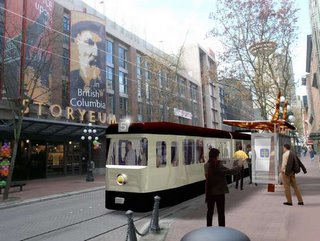
A rendering of the future streetcar in Gastown.
A weekend streetcar service ran on part of this line until 2009, staffed by volunteers and making use of antique cars. I lived a hundred metres from the track and enjoyed riding to Granville Island on Saturday afternoon. The new service would be more modern and attractive, but to a large extent it would fulfill the same touristic and local lifestyle function as the old line. I would love to see a modern streetcar in operation, but it is not an essential component for the regional transportation system.
TransLink: fuel taxes and revenue
As noted in my September 15 post, Metro Vancouver’s transportation authority is looking for ways to scare up an additional $70 million per year for service expansion.
In the current proposal, a 2 cent lift in the regional fuel tax is supposed to cover $40 million of this. But in a presentation in Maple Ridge, TransLink CEO Ian Jarvis cautioned that the motor fuel tax may not be the reliable cash cow it used to be; and in the foreseeable future, fuel tax revenues may drop. Continue reading
TransLink and the Evergreen Line: Let’s make a deal
TransLink, aka the South Coast British Columbia Transportation Authority, moves about 600,000 transit passengers on the average day in Metro Vancouver. Forgiving the occasional breakdown, the corporation seems to have most of its technical issues sorted out.
But on the softer side – politics and financing – the outlook is uncertain. TransLink’s operates as a unified agency in a fractured region. Its funding requests are subject to approval by a council of 21 municipal mayors – and yes, this includes Anmore, Belcarra, Bowen Island and Lions Bay – plus a first nations chief. If the mayors happen to agree on something, their decision is subject to further approval by the provincial government. Continue reading
 Fraseropolis